CMMS Software Trends: 6 Technologies Transforming Maintenance Management
Modern CMMS software is evolving beyond traditional maintenance scheduling and work order management. Technologies such as IoT, artificial intelligence, mobile workforce tools, cloud platforms and predictive analytics are changing how organizations monitor assets, coordinate maintenance teams and make operational decisions.
The most important CMMS software trends are not simply about adding new features. They reflect a broader shift toward connected maintenance operations where assets, technicians, workflows and enterprise systems work together.
For organizations managing complex maintenance environments, understanding these developments can help determine which capabilities will deliver real operational value and which technologies require greater investment, data maturity or organizational change.
Below, we explore six technologies transforming modern maintenance management and what enterprises should consider when evaluating their next generation of maintenance software.
Why CMMS Software Is Evolving
Traditional Computerized Maintenance Management Systems (CMMS) were primarily designed to digitize maintenance records, schedule preventive maintenance and manage work orders.
Those capabilities remain essential, but enterprise maintenance operations have become considerably more complex.
Organizations may now need to coordinate hundreds or thousands of assets across multiple sites, manage mobile technicians and contractors, meet strict service-level agreements, maintain regulatory compliance, control material consumption and respond rapidly to changing asset conditions.
As a result, modern maintenance platforms are increasingly expected to do more than record maintenance activity. They need to connect asset information with people, processes and operational workflows while providing management with real-time visibility into performance.
This evolution is driving several important CMMS software trends.
1. IoT Integration: From Asset Monitoring to Predictive Action
IoT is changing maintenance management by allowing organizations to continuously collect operational data directly from connected assets and equipment.
Sensors can monitor conditions such as temperature, vibration, pressure, operating hours or other equipment-specific measurements. Instead of relying entirely on scheduled inspections or technicians identifying problems manually, maintenance teams can use this information to detect abnormal conditions earlier.
The real value, however, comes from what happens after the data is collected.
In an integrated maintenance environment, an abnormal asset condition can trigger a maintenance workflow:
Asset sensor → condition detected → maintenance requirement identified → task generated → technician assigned → corrective action completed → maintenance history updated.
This transforms IoT data from passive monitoring into operational action.
IoT integration can therefore support condition-based maintenance and predictive maintenance, helping organizations intervene before equipment failure leads to costly downtime or service disruption.
However, IoT should not be treated as a simple software feature. Successful implementation may require investment in sensors, connectivity, asset-data architecture and technical expertise. The quality of the resulting maintenance decisions will also depend heavily on the accuracy and reliability of the underlying data.
Organizations considering IoT-enabled maintenance should therefore evaluate whether their CMMS can integrate asset data with the workflows used to manage actual maintenance activity.
2. AI-Enabled CMMS: Smarter Maintenance Decisions
Artificial intelligence is becoming another important capability within modern maintenance platforms.
AI can help maintenance teams analyze large volumes of operational information and identify patterns that would be difficult to detect manually. Depending on the application, this can support areas such as maintenance prioritization, technician scheduling, resource allocation, anomaly detection, inventory planning and asset failure prediction.
For example, a maintenance operation may have hundreds of outstanding work orders across different locations. Intelligent scheduling can help determine which technician should receive each task based on factors such as skills, availability, location, priority and SLA requirements.
More advanced applications can analyze historical asset performance and maintenance records to identify patterns associated with future equipment failure.
However, AI is only as useful as the operational data and business logic supporting it.
Organizations with fragmented asset records, inconsistent maintenance histories or poorly structured operational processes may struggle to generate meaningful AI-driven insights.
For this reason, enterprises should avoid evaluating AI capabilities in isolation. The stronger question is whether the maintenance platform can combine accurate operational data, configurable business rules and AI-assisted decision-making to improve real maintenance outcomes.
3. Mobile-First Maintenance: Connecting the Frontline Workforce
Maintenance operations rarely happen behind a desk.
Technicians, engineers, supervisors and contractors spend much of their time working across facilities, customer locations, infrastructure networks and industrial environments. As a result, mobile access has become a fundamental requirement for modern maintenance management.
A mobile-enabled CMMS allows frontline teams to receive assignments, access asset information, update work orders, complete checklists, record material consumption and capture operational data directly from the field.
This reduces the administrative burden associated with paper forms, phone calls, spreadsheets and duplicate data entry.
It also improves the quality and timeliness of operational information.
Instead of waiting for technicians to return to an office and update a system later, organizations can capture maintenance information at the point where the work is performed.
For complex field environments, organizations should also consider whether mobile applications support capabilities such as offline operation, photographs, digital forms, checklists, GPS information and real-time synchronization.
The result is not simply greater mobility. It is a more connected maintenance workforce where field execution and management visibility operate from the same source of information.
4. Cloud-Based CMMS: Scalability, Integration and Lower Complexity
Cloud deployment has become one of the most significant shifts in enterprise software, and maintenance management is no exception.
A cloud-based CMMS can reduce the infrastructure and administrative burden associated with maintaining on-premise systems while enabling faster deployment, easier upgrades and greater scalability.
For organizations operating across multiple sites or countries, cloud platforms can also provide a consistent operational environment without requiring separate infrastructure at every location.
Another important advantage is integration.
Modern maintenance operations increasingly need to exchange information with ERP platforms, IoT systems, customer portals, workforce applications, procurement systems and other enterprise technologies. Cloud architectures and APIs can make these integrations easier to deploy and maintain.
However, organizations should still evaluate important enterprise requirements including data residency, information security, system availability, access control, integration architecture and regulatory compliance.
The decision should therefore not simply be cloud versus on-premise. Enterprises should evaluate which architecture provides the appropriate combination of scalability, security, integration capability and operational resilience.
5. Predictive and Proactive Maintenance: Moving Beyond Reactive Work
One of the most important CMMS software trends is the shift from reactive maintenance toward increasingly proactive and predictive maintenance strategies.
Reactive maintenance begins when something fails.
Preventive maintenance attempts to reduce that risk through scheduled inspections and servicing.
Predictive maintenance goes further by using asset conditions, historical information and analytics to determine when intervention is actually required.
The potential benefits are significant: fewer unexpected failures, improved asset availability, better use of maintenance resources and potentially longer asset life.
But achieving predictive maintenance requires more than purchasing software.
Organizations typically need a digital maintenance environment, reliable asset information, connected operational processes, sufficient historical data and clearly defined maintenance logic. More advanced predictive models may also depend on IoT data and machine learning.
For many organizations, the practical journey therefore begins by improving the quality of maintenance data and digitizing existing workflows before introducing more sophisticated predictive capabilities.
A modern maintenance platform should support this progression rather than forcing organizations to adopt every technology simultaneously.
6. Data-Driven Maintenance: Turning Operational Data Into Action
Data-driven maintenance means making operational decisions using accurate and timely information generated throughout the maintenance process.
That information may come from technicians, assets, IoT devices, inspections, customers, contractors or enterprise systems.
Even without advanced AI or IoT, a maintenance platform can provide substantial value when it consistently captures structured information about work orders, asset history, response times, technician performance, material consumption, costs, failures and SLA performance.
This creates the foundation for better operational decisions.
Managers can identify recurring asset problems, understand where maintenance resources are being consumed, measure response and resolution times, monitor SLA performance and compare results across sites or contracts.
The objective should therefore go beyond producing dashboards.
A strong maintenance platform should help organizations convert operational information into action by connecting data with the processes used to assign work, escalate problems, allocate resources and improve future maintenance decisions.
From CMMS to Connected Maintenance Operations
The technologies transforming CMMS software become considerably more valuable when they work together.
An IoT sensor may identify an abnormal asset condition. Analytics may determine that intervention is required. But the organization still needs to decide what happens next.
Who should respond? What skills are required? Is an approval needed? Are materials available? What SLA applies? Does the customer need to be informed? What happens if the task is not completed within the required timeframe?
This is where maintenance management increasingly intersects with Enterprise Workflow Orchestration.
Workflow orchestration connects information from assets and enterprise systems with the people and operational processes responsible for delivering the work.
A connected maintenance process might therefore look like:
Asset condition detected → maintenance workflow triggered → appropriate resource identified → task assigned → approvals and materials coordinated → work completed → asset history updated → performance measured.
For enterprises managing complex operations, this ability to connect maintenance activities across people, assets and systems can be just as important as the individual CMMS features themselves.
What Should Enterprises Look for in Modern CMMS Software?
With maintenance technology evolving rapidly, organizations should avoid selecting a platform based solely on the number of features available.
The more important question is whether the platform can support the organization’s operational model today while adapting to future requirements.
Key capabilities to evaluate include:
- Asset and maintenance management: The ability to maintain accurate asset records, maintenance histories and service requirements.
- Work order management: Configurable processes for creating, assigning, prioritizing, tracking and completing maintenance work.
- Preventive and predictive maintenance: Support for scheduled, condition-based and increasingly predictive maintenance strategies.
- Mobile workforce capabilities: Tools that allow technicians and field teams to execute work efficiently from any location.
- Workflow configuration: The ability to adapt maintenance processes, approvals, escalations and business rules without excessive customization.
- Integration: APIs and integration capabilities for connecting ERP systems, IoT platforms and other enterprise technologies.
- SLA and compliance management: Visibility into service commitments, escalation requirements and compliance-related activities.
- Operational analytics: Dashboards and reporting that convert maintenance information into actionable insights.
- Scalability: The ability to support additional assets, sites, users, contracts and operational complexity as the organization grows.
The best solution is not necessarily the platform with the longest feature list. It is the one that can support the organization’s actual maintenance processes while providing the flexibility to evolve as those processes change.
How MIMS Supports Modern Maintenance Operations
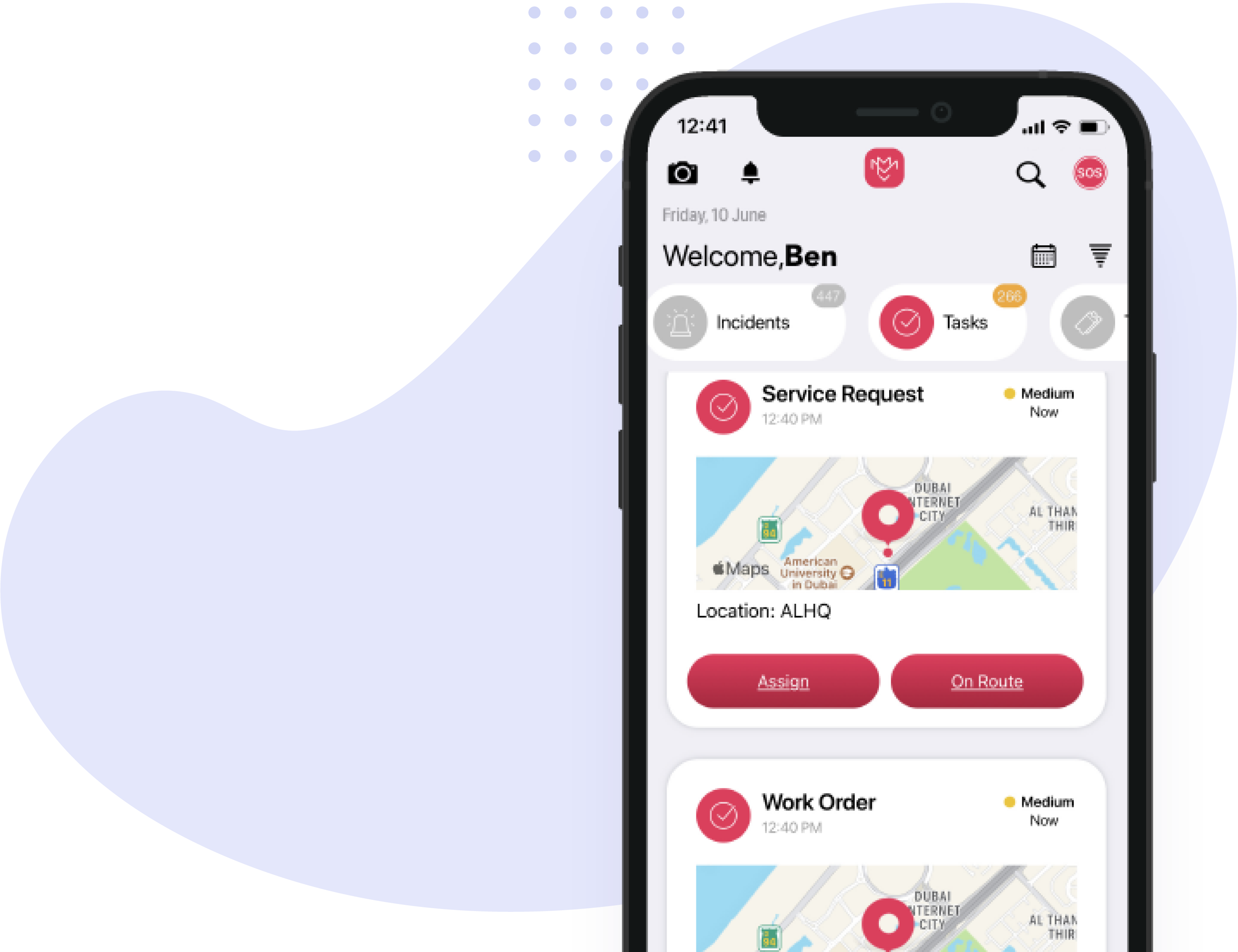
MIMS Maintenance Management Software helps organizations manage maintenance operations across assets, work orders, mobile teams and operational workflows from a unified platform.
MIMS enables organizations to coordinate maintenance activities from initial request through assignment, execution and completion while maintaining visibility into asset history, workforce activity, material consumption, SLA performance and operational results.
Its configurable workflow capabilities allow organizations to adapt maintenance processes to different assets, facilities, customers, contracts and operational requirements.
Mobile workforce capabilities extend these processes to technicians in the field, allowing operational information to be captured directly where maintenance activities take place.
By connecting maintenance workflows with asset information, workforce management, operational data and enterprise integrations, organizations can move beyond isolated maintenance transactions toward a more connected service delivery environment.
Frequently Asked Questions About CMMS Software
What is CMMS software?
CMMS stands for Computerized Maintenance Management System. CMMS software helps organizations manage maintenance operations by organizing asset information, work orders, preventive maintenance schedules, maintenance histories and related operational data.
What are the most important CMMS software trends?
Major CMMS software trends include IoT integration, artificial intelligence, mobile-first maintenance, cloud deployment, predictive maintenance and greater use of operational data for maintenance decision-making. Increasingly, these capabilities are also being connected through automated workflows and enterprise integrations.
How do AI and IoT improve CMMS software?
IoT can provide real-time information about asset conditions, while AI can analyze operational and historical data to support areas such as anomaly detection, maintenance prioritization, scheduling and asset failure prediction. Their effectiveness depends heavily on data quality and integration with maintenance workflows.
Is a cloud-based CMMS better than an on-premise system?
Cloud CMMS platforms can provide advantages including scalability, faster deployment, easier upgrades and reduced infrastructure requirements. However, enterprises should evaluate cloud and on-premise options against their specific requirements for security, data residency, integration, availability and regulatory compliance.
What is the difference between preventive and predictive maintenance?
Preventive maintenance is typically performed according to predefined schedules or usage intervals. Predictive maintenance uses asset conditions, historical data and analytics to determine when maintenance intervention is likely to be required.
Can CMMS software support mobile maintenance teams?
Yes. Modern CMMS platforms can provide mobile access to work orders, asset information, checklists and other maintenance data, allowing technicians to receive assignments and update maintenance activity directly from the field.
The Future of CMMS Software
The future of CMMS software is not simply about adding more technology. It is about creating increasingly connected maintenance operations.
IoT can provide greater visibility into asset conditions. AI can support better operational decisions. Mobile technology connects frontline teams. Cloud platforms improve scalability and integration. Predictive analytics can help organizations intervene before failures occur.
But the greatest value emerges when these capabilities work together.
Organizations that connect assets, people, data and maintenance workflows can move beyond reactive maintenance toward more proactive, efficient and resilient operations.
For enterprises evaluating their maintenance technology strategy, the objective should therefore be broader than selecting a system for managing work orders. The goal should be to establish a digital maintenance environment capable of supporting changing operational requirements, improving service delivery and enabling better decisions over the long term.
Learn more about how MIMS Maintenance Management Software helps organizations connect assets, maintenance teams and operational workflows.
Related: Explore how Enterprise Workflow Orchestration connects people, systems and processes across complex service delivery operations.